


Updated October 2026 · espresso ratio by bean density
The ratio compares how much ground coffee you use (the dose) with how much coffee you make (the yield). In the Coffee Recipe Series it changes with the density of your roasted beans: 1:1 for the darkest roasts up to 1:4 for the lightest, spread evenly across all 121 recipes.
Ratio = yield ÷ dose. An 18 g dose stopped at 36 g is 1:2; a 20 g dose stopped at 40 g is also 1:2 and tastes the same. Dark roasts need low ratios and light roasts high ones: 1:1 at 0.330 g/ml, 1:2.5 at 0.390 g/ml and 1:4 at 0.450 g/ml.
Why ratio matters
Water is a powerful solvent. Because of its polarity and its ability to form hydrogen bonds, it can dissolve many different molecules. That is what you are doing when you make coffee: dissolving flavour compounds out of the grounds. The more solvent you use, the more compounds you extract.
Under-extracted coffee is sour, so you need to extract more by using more water. Over-extracted coffee is bitter, so you need to extract less by using less water.
Ratio is the most important parameter to change when making coffee. In golf terms it's your big driver, your most powerful club. Never varying your ratio is like playing golf with only a putter. That might be fine for the kids on the mini-golf course, but you want to be out with the pros, using all your tools to make the best-tasting coffee possible.
The ratios
The standard espresso ratios are:
Very dark roasts taste sweeter and less bitter at low ratios.
Became the standard. That doesn't mean it suits every roast level. Far from it.
For light roasts, which taste sour with too little extraction.
For very light roasts, which need the most water.
These are the rough names. In reality ratio is a continuous scale; you might need 1:2.7, for example. If you try a very light roast at a fixed 1:2 or even 1:3, you put far too little water through. No amount of grind adjustment can compensate, and you will make a sour coffee. That is why most people don't even try light roasts as espresso, and they are missing out. Don't be afraid of light roasts on espresso: use the higher ratios.
Generally, I'm not a fan of dark roasts because they tend to burn off the fruit notes. But faced with one, a low ratio and a lot of milk plus a little cream can make a delicious result. One particularly memorable coffee was a Pacamara from Los Naranjos Café, roasted by Cypher Roastery. The 1:1 ratio removed the bitterness, leaving it sweet and syrupy with a long finish. Delicious.
My partner's favourite espresso was a Pacamara from El Gutalon in Guatemala, roasted by Cypher Roastery. She described it as lemon sponge cake, unlike any coffee she had ever had. My notes: “Wow, absolutely extraordinary. I've never had such an orange citrus coffee before. The nose is lovely, with some almond notes which I adore. The flavour is explosive, the lively acidity is right, and the crisp finish is just beautiful. I had a huge smile on my face for hours.”
The chart
Across the series, the ratio rises in a straight line with density, from 1:1 at 0.330 g/ml to 1:4 at 0.450 g/ml.
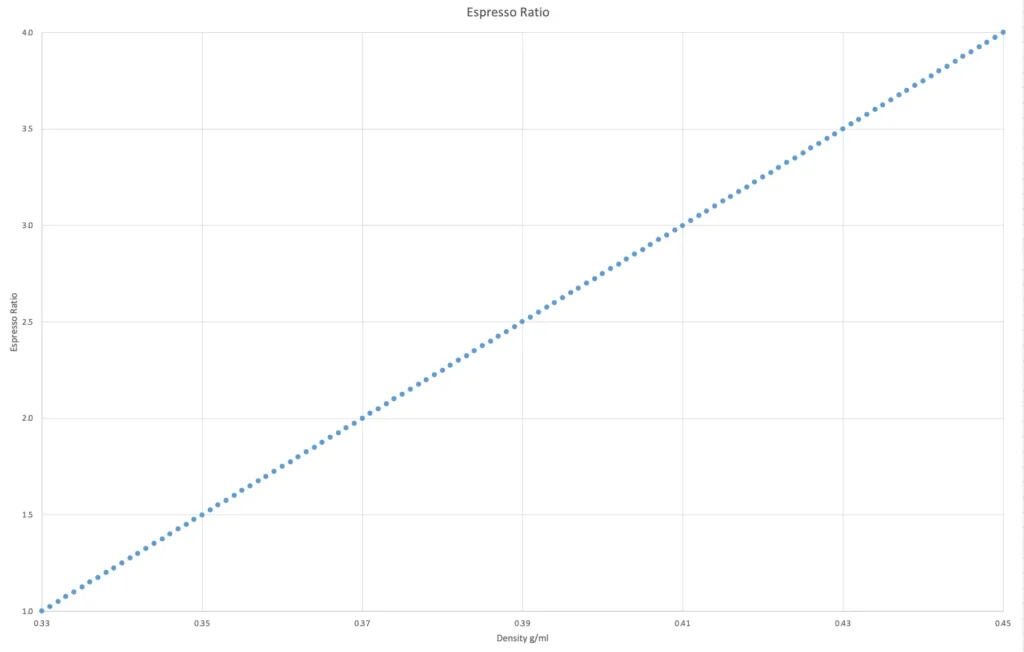
Espresso ratio (1:x) against roasted bean density (g/ml)
at 0.330 g/ml, the darkest roasts (Recipe 1)
at 0.390 g/ml, the middle of the series (Recipe 61)
at 0.450 g/ml, the lightest roasts (Recipe 121)
Using the right ratio for the roast level, as indicated by the density, can make all the difference between success and failure.
Find your ratioWorking with what you have
Generally, if you are following the recipe, you don't need to know the ratio. But say you only have an 18 g basket, and a recipe calls for a 24 g dose with a 29 g yield, a ratio of 1:1.2. You can keep your 18 g dose and use the ratio to calculate the yield.
18 g × 1.2 = 21.6 g. Same ratio, same taste.
With the same ratio the coffee will taste the same. With a smaller 21.6 g yield instead of 29 g, scaling the cup down from 240 ml to 220 ml would also be advisable. See the espresso yield calculator and how to choose an espresso basket.
Ratio misuse
Some people believe it is traditional to use only a 1:2 ratio for espresso. Some more modern people believe 1:2.5 is better. Some arbitrarily decide ristretto is their thing, or that lungo is where it's at. All these statements are wrong: you need the right ratio for the roast level you have.
Over-extracted and bitter.
Under-extracted and sour.
If you are not using all the espresso ratios available to you, you are really limiting your ability to make better-tasting coffee.
Keep reading
Find your starting recipe, then dig deeper into what drives extraction.
Find your recipe
