


The size of the roasted coffee bean can affect extraction, learn how.
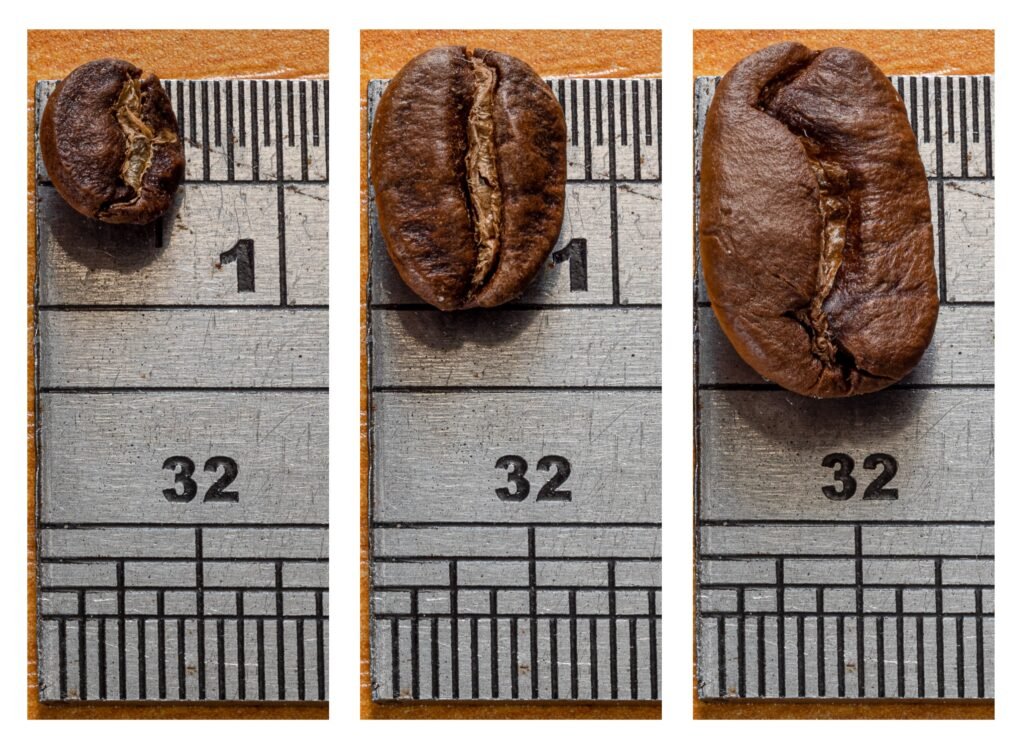
Coffee seeds increase in size throughout the roast, expanding to about 1.5 times the size of the original green bean.
Seed size affects the degree of roasting and can offset the density indicator.
Very small seeds tend to be more thoroughly roasted, making them more susceptible to over extraction. You may find the recipeseries.coffee result a bit bitter, press Extract Less (one step down the series) to compensate.
Very large seeds tend to be less thoroughly roasted, making them more susceptible to under extraction. You may find the recipeseries.coffee result a bit sour, press Extract More (one step up the series) to compensate.
It is recommended you try the default setting first, as the roaster may have successfully catered for the size during the roast.
Measure the seed across the width, not the length!
In my own notes on 222 coffees brewed as espresso with the Coffee Recipe Series, bean size was the most common reason I had to change the starting recipe. Unusually small beans tended to behave like a darker roast and needed a step less extraction; unusually large beans needed a step more. It is still the exception rather than the rule, so try the density-matched recipe first.
Roasted coffee is colloquially referred to as a “bean”, but it is not a bean—it’s the seed of a fruit – Lucia Solis.
Quoted from coffea.earth, Coffee Atlas: Bean size
The final taste of coffee is determined by several factors, like coffee variety, farm altitude and soil. One of the important factors is also coffee seed size.
After coffee is harvested and processed, the green seed has to be sorted by size. Coffee seeds are sorted by size into categories using sorting screens. The number indicates the size – 8 means the diameter of the holes in the screen is 8/64 of an inch. That’s the theory.
In practice, the screens are placed successively. The seeds first have to pass through the highest number, for example 18. If they don’t pass it, it means the seeds are bigger than 18/64 of an inch, or 0.7 cm. The others fall through to number 17, some stay there, some continue, and so on until the smallest screen. The seeds are graded with the number of the last screen through which they passed.
Peaberry seeds are usually sorted in a special way, because of their different shape. The holes in the screen are rectangular to reflect the peaberry shape.
Some countries do not have any standards for grading coffee, but at the same time, many countries have developed their own classification systems. Luckily, thanks to the screen sizes, they can be roughly translated between each other.
Bigger seeds tend to taste better, because they mature for a longer time on the tree and thus should be more developed. Seed size is usually also linked to altitude of growth. But as to every rule, there are countless exceptions. Elephant seeds are often too large to support themselves and crack while ripening and become tainted. And even if they are successfully harvested and sorted out, they often crack too early during roasting anyway, tainting the sample.
The most suitable seeds are sizes 14, 16 and 18, which offer the best ratio between taste quality and reliability. This is also not true in all cases, though. Most heirloom coffees, typical for Ethiopia and some other African countries, fall into the smaller seed categories. But they also happen to often be the most interestingly tasting coffees in the world. That’s why Ethiopia has never really developed any standardisation for coffee sizes, and concentrates purely on cup quality.
In other countries, smaller seed sizes are usually considered inferior, do not qualify as specialty coffee and are sold at a lower price. Even peaberry coffees, considered by many to be the highest quality of seed, fall in the same category as coffee shells in some Latin American countries. That’s because they were traditionally considered a defectively developed, mutated seed.
The only objectively measurable reason to sort coffees by size throughout the world is to guarantee a uniform roast of the seeds.

