

Updated October 2026
The best way to store coffee beans is to freeze them whole, in small sealed single-dose containers, as soon after roasting as you can, then grind them straight from the freezer. These nine tips explain why, and what I do myself.
Roasted coffee loses most of its aroma within about ten days at room temperature, even in a good bag with a one-way valve. Freezing is the only thing that really slows that down.
Weigh your beans into single doses, seal them in small reusable pots, and freeze them on the day they are roasted. Take out one pot per brew, grind the beans frozen, and never defrost or refreeze.
Each tip links to the full explanation further down the page.
Tip 1
70% of the aroma molecules are lost within ten days of storing freshly roasted whole-bean coffee, even in unopened poly-aluminium laminated bags with a one-way valve, at room temperature.
A busy café will use a 3 kg bag in a few hours, which is why commercial grinders have big hoppers. At home, making one or two cups a day, a 250 g bag can take a month to finish.
The aroma and flavour of coffee are Volatile Organic Compounds (VOCs). They escape with the carbon dioxide that diffuses out of the beans, including out through the one-way valve. Good bags reduce the oxygen and moisture reaching the beans, but they do not slow the loss of aroma, flavour and freshness.
Changing how you store coffee at home will improve it, because fresh coffee tastes better than old coffee.
Tip 2
Freezing slows the kinetic reactions that make coffee stale. A 25°C difference in temperature decreases freshness loss by 100-fold.
A domestic freezer can keep coffee fresh for three months to a year.
It continues in the freezer, but seventy days in the freezer is about the same as two days out.
Storing whole-bean coffee in a freezer will significantly prolong its freshness. Top cafés worldwide are already doing it:
Proud Mary Chills Out – Why Nolan Hirte is Freezing Everything
2022 Is the Year We All Freeze Our Beans – Barista Magazine Online
Tip 3
Ideally, get the coffee from the roaster, then single-dose and freeze it the same day, within hours if you can. Talk to your roaster about what you need. They will be glad to help.
I am lucky enough to have a fridge with a freezer at work. I arrange a day with the roaster. They usually roast in the morning and have the bags ready for me to pick up on my way to work. I have the scales and storage pots with me, and it only takes a few minutes to weigh the doses and put all the pots in a plastic bag in the freezer at work. I use a chiller bag and a frozen block to keep them cool on the train ride home.
It sounds like a lot of effort, but it really is not, and you get awesome, really fresh coffee for months from it.
Tip 4
When you take coffee out of the freezer and open the container, humidity condenses on the frozen beans. Coffee is hygroscopic, so it absorbs that moisture, which does more harm than good. It is why you can find people recommending against freezing coffee.
Freezing one large container, opening it, taking a portion and refreezing the rest is not a good idea.
Freeze individual single doses shortly after roasting. Each pot is opened once, when you are ready to grind it.
Tip 5
Oxidation stops at low temperatures, so you do not need to keep frozen coffee in an oxygen-free environment such as vacuum packaging.
Freezer burn is water lost from food by sublimation and redeposited on its surface as ice crystals. It affects foods with a high moisture content: meat, fish, fruit and vegetables. The moisture loss shrivels fruit and vegetables and gives meat a leathery texture and dark spots. The dehydration also creates pockets that are open to the air, which speeds up oxidation, and in fatty foods that can cause unpleasant flavours.
Roasted coffee is very dry, around 2% moisture content, because roasting vaporises the water. Freezer burn is not an issue with roasted coffee, which is another reason vacuum packaging is unnecessary.
Tip 6
Small reusable sealed containers are ideal. Weigh one dose per pot, so each pot is opened once.

70 ml plastic screw-top pots work well.
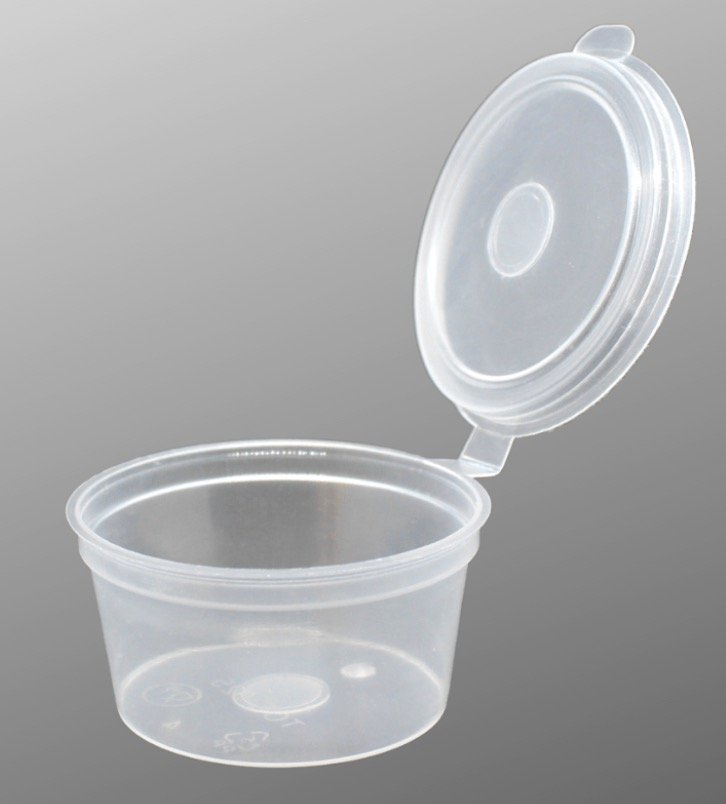
25 ml lidded sauce pots do the job.

Single-dosed espresso, ready for the freezer

Single-dosed filter pots
Tip 7
There is a theory that coffee needs to rest after roasting before you use it. This comes down mostly to how you make the coffee. Immediately after roasting, a large volume of CO₂ diffuses out of the beans.
With filter methods such as V60, the bloom phase lets most of the CO₂ escape as the water first hits the coffee. A crust forms as CO₂ floats some grinds to the top, and you can break and stir it in to help extraction. A resting period is unnecessary for filter methods.
With espresso the coffee is compressed in a puck and has only 20–30 seconds of contact with the water. There is a theory that the excess CO₂ of very freshly roasted coffee impedes extraction and leads to channelling and uneven extraction. The standard advice is to wait three to four days, but as we know, a lot of aroma and flavour is lost in that delay.
If you do have trouble with very fresh coffee, there are better fixes than waiting:
Some espresso machines can wet the bed at a low 1–2 bar for a few seconds, similar to a bloom, before ramping up to 9 bar.
Leave up to 15 minutes between grinding and extraction. The extra surface area lets the gas escape much faster.
Use a naked portafilter and a mirror to watch for spurts. Examine the spent puck for light and dark patches, which signal uneven extraction.
Samo Smrke's studies at the Coffee Excellence Center at Zurich University of Applied Sciences (ZHAW) found that:
Coffees with no resting time showed the slowest decline in score over time compared with rested coffees.
Non-rested coffee lost quality more slowly than coffee rested before packaging, perhaps because fewer volatile compounds were lost before the coffee was protected.
For maximum freshness, single-dose package and freeze your coffee as soon as possible.
My test
I tested four 150 g bags roasted in the same batch on Thursday 3 August 2023 at 8:30 am and packaged by the roaster (Mojo). I single-dosed and froze one bag at each stage below, then tasted them after ten days.
Day 0
Bag 1, frozen at 9:30 am, one hour after roasting. Very good: sparkling, vibrant fruit notes with the toasted nutty notes. I would purchase more. Scored 75.
Day 3
Bag 2, frozen Sunday 6 August. The difference from bag 1 was still noticeable. Freezing immediately was the best way to store coffee for freshness. Scored 72.
Day 7
Bag 3, frozen Thursday 10 August. Not good enough to buy more. Scored 68.
Day 10
Bag 4, frozen Sunday 13 August. OK, but I would not buy more. A night-and-day difference from bag 1: almost no fruit notes, flat and lifeless, with toasted nutty notes but pretty average. Scored 65.
The result is a one-way street: the longer the coffee is out of the freezer, the worse it gets.
I had no trouble extracting bag 1 on my manual lever Flair 58, where I can control pre-infusion and the flow through the puck. Machines with pumps or heavy springs and less control could have issues.
Fruit flavours and acidity are the first VOCs lost. Some people have a low tolerance for acidity in coffee, but I would rather manage that with roast level than with stale coffee. Very light roasts can taste green and vegetal, which does fade with staling. Staling is a tool to cope with roast flaws, but it is pretty desperate.
Do your own tests and decide your own preference. My conclusion is that I will get all my coffee from the roaster into the freezer as soon as possible.
Tip 8
After coffee is ground, the off-gassing rate increases dramatically. Nearly 70% of the CO₂, aroma and flavour is lost within one day of grinding, so do not buy pre-ground coffee.
The longer the gap between grinding and brewing, the more aromatic flavour you lose. Cut the time between grinding and making your espresso to the minimum.
Tip 9
Grinding frozen beans improves the uniformity of the grind, so do not defrost before grinding. Coffee scientist Chris Hendon worked on a 2016 study that explored grinding frozen coffee.
Take out one pot per brew and grind straight from the freezer. There is no thawing step and nothing to refreeze.
Why it matters
There is no substitute for fresh roasted, freshly ground coffee. Coffee has the most flavour when it is fresh out of the roaster.
Aroma: strong and enticing, with distinct notes specific to the origin and roast profile.
Flavour complexity: a wide range of more pronounced flavours: fruity, floral, nutty, chocolatey and more.
Acidity: bright and pleasant, adding liveliness to the brew.
Body: fuller, with a richer and more satisfying mouthfeel.
Crema: a thicker, creamier layer on an espresso shot. Only fresh coffee produces it.
Vibrancy: lively and more enjoyable to drink.
Bland, dull and flat.
Hardly any aroma.
May be bitter.
Lifeless, and lacking in crema.
The science
Dry green beans, if stored properly, can last over a year. Roasting changes the physical structure of the bean and creates volatile compounds that are physically off-gassed. That is where the trouble starts.
Staling is degradation by oxygen, temperature and moisture. Aroma compounds are lost, and oxidation forms new compounds that taste off. Off-flavours and rancidity can form even under vacuum or at low oxygen levels, because free radicals produced during roasting still cause lipid oxidation.
The gas released from coffee in storage was analysed as about 87% CO₂, 7.3% CO and 5.3% nitrogen, with the rest VOCs, or aroma compounds. The mix varies with variety, roast degree and roast profile. The darker the roast, the more gas is lost, and the faster.
Grinding increases the off-gassing rate by up to a factor of ten. Released CO₂ can also react with water to form carbonic acid, so very fresh coffee with a high CO₂ content may taste more acidic.
Just one week after roasting, tasters preferred coffee that had been stored frozen. Coffee stored at room temperature for a week was "distinctly less odor-intensive" and showed "less aroma freshness". You can use Arrhenius' law to calculate the best freshness period for a given storage temperature.
Perceptible quality loss shows up in the first 7–10 days after roasting.
Coffee rested before packaging scores lower and stales at the same rate as non-rested coffee, having lost many volatiles during prolonged exposure to air.
Package your coffee as soon as possible after cooling, and avoid buying too much at once.
History
In 1955 Alfred Peet moved to San Francisco to work for a coffee importer and was dismayed that Americans were drinking such inferior coffee. His view: "I came to the richest country in the world, so why are they drinking the lousiest coffee?"
On 1 April 1966 he opened his coffee shop in Berkeley, California, on the corner of Vine and Walnut streets near the university campus. For Peet, the shortest possible distance between the roaster and the customer was crucial, and he only used high-quality beans. In 1971 three young entrepreneurs came to learn the business, and for two years he trained them and supplied roasted beans for their new company, Starbucks.
Freshness is the difference between a unique sensory experience and a mediocre cup of coffee. Read more at The History of Peet's Coffee.
FAQ
Freeze whole beans in small, sealed, single-dose containers as soon after roasting as possible. Take out one pot per brew and grind the beans straight from the freezer. Freezing is the only method that really slows staling.
At room temperature, about 70% of the aroma molecules in freshly roasted beans are lost within ten days, even in an unopened valve bag. In a domestic freezer at −20°C, coffee can stay fresh for three months to a year.
Yes, and it is the best way to keep them fresh. Freeze them whole, in single doses, in dry sealed containers. Do not freeze one large container and keep reopening it, because moisture condenses on the cold beans every time.
No. Grind them straight from the freezer. Grinding frozen beans improves the uniformity of the grind, so do not defrost them first.
It is best not to. Each time a container is opened, humidity condenses on the frozen beans and the coffee absorbs it. That is why single-dose pots are the answer: each pot is opened once.
I do not. A fridge is not cold enough to slow staling anywhere near as much as a freezer, and opening a container of cold beans still lets moisture condense on them. Use the freezer with single-dose pots instead.
No. Oxidation stops at freezer temperatures, so you do not need an oxygen-free environment, and roasted coffee is dry enough (around 2% moisture) that freezer burn is not an issue. Small reusable sealed pots are cheaper and better for the environment.
No. In the ZHAW studies, coffee with no resting time declined in score most slowly. Filter methods release CO₂ in the bloom, and for espresso you can use pre-infusion or grind a few minutes early rather than waiting days.
For espresso doses of 14–25 g, 70 ml plastic screw-top pots work well. For filter doses of 11–15 g, 25 ml lidded sauce pots do the job. Both are reusable and cheap.
No. Nearly 70% of the CO₂, aroma and flavour is lost within one day of grinding. Buy whole beans and grind just before brewing.
Keep reading
Fresh, well-stored beans deserve a recipe that suits them. These guides take you through the rest of the process.
How to choose specialty coffee worth freezing in the first place.
Read the guideA starting recipe for every bean density, with up and down navigation by taste.
Start at recipe 61Specialty Coffee Association (SCA) Coffee Freshness Handbook, research conducted by the Coffee Excellence Center at Zurich University of Applied Sciences (ZHAW), published in 2018.
Further reading: Proud Mary Chills Out, Barista Magazine: 2022 Is the Year We All Freeze Our Beans, grinding frozen coffee study, The History of Peet's Coffee.
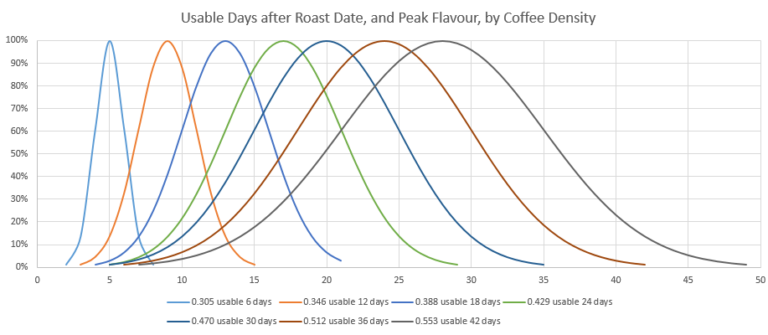
recipeseries.coffee used to provide a mathematically generated coffee ageing table, based on the theory that coffee can be too fresh and that roasted coffee needs time to mature. Darker roasts, being much less dense, matured very quickly and had a short window of usability. Very light roasts took longer and had a much wider window.
I no longer believe this advice is true. If you still want to use it, the ageing table image is below.