


Missed Step 1? see How to measure density
If you used 1g accurate scales, it’s recommended you get 0.1g accurate scales. But you can enter 0.38g/ml padded with zero, ie 380
There are two ways of using the coffee recipe series on this site.
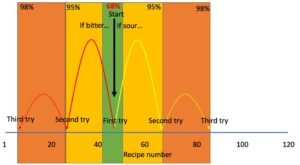
The idea is, when you taste the coffee:
– if the coffee is sour, you extract quite a bit more by next trying a recipe 20 places up the series.
– if the coffee is bitter, you extract quite a bit less by next trying a recipe 20 places down the series.
So either:
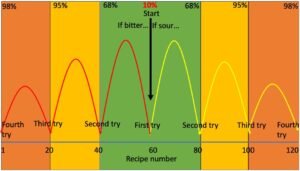
2. The second way is to get yourself a measuring cylinder (you should already have digital scales) and measure the density your bag of coffee beans. A cylinder is cheap, and the process takes less than a minute per bag.
Coffee density is the weight of a 100ml of coffee beans proportional to its volume. So if 100ml of coffee beans in a good volumetric cylinder
weigh for example 37.7g, then the density is 0.377 g/ml.
Why this is important is because density correlates highly with Roast Level, the more you roast coffee, the lighter it gets.
If your coffee is darkly roasted, you will need to extract less or it will be bitter.
If your coffee is lightly roasted you need to extract more or it will be sour.
You need two things:
A decent scale is one of the cheapest upgrades you can make to your setup, and one of the most consequential — because everything in the Coffee Recipe Series starts with an accurate density reading. If the scale is wrong, the recipe it points you to is wrong before you’ve even started brewing.
The number printed on the box — “0.1g” or “1g” — is the scale’s resolution: the smallest increment it can display. It isn’t the same thing as accuracy. A cheap scale advertised at 1g resolution is often only accurate to within a couple of grams either way, because the underlying load cell is a generic, uncalibrated component rather than one tested and rated for that tolerance. On an 18g dose, a ±2g error is over 10% — more than enough to put you a full cohort away from where you actually should be on the density table.
Refresh rate matters just as much, and it’s rarely advertised at all. A scale built for coffee typically samples and updates its display 10 or more times a second, so what you see tracks what’s actually happening as you pour. Budget kitchen scales often refresh once a second or slower, and many of them also apply a noise filter that suppresses small changes below a set threshold — sometimes a gram or more — so the number on screen doesn’t move until enough weight has already been added to clear that threshold. During a slow bloom or a fine pour-rate adjustment, that lag means you’re already past your target by the time the display catches up.
None of this matters much for weighing something static, like a bag of flour. It matters a great deal for weighing beans to calculate a density, and for pouring water against a moving target — which is exactly what this site asks you to do. A scale built for coffee (rather than the kitchen drawer) removes that error from the one measurement the whole system depends on. The Booko Scales are recommended.
Get one with a Tolerance (mL) ±0.50 and preferably Borosilicate.
or
The Coffee Recipe Series principle works for all ways of making coffee.
Recipe Series are provided for Espresso, Filter, Aeropress, French Press Plunger and Drip Pot.
The Coffee Recipe Series principles work for all metods of making coffee.
Recipe Series are provded for five Brew Methods — Espresso, V60, French Press, Aeropress & Drip Pot.
