


Updated October 2026 · brew temperature by bean density
Higher temperatures extract soluble compounds much more easily than lower temperatures. In the Coffee Recipe Series, espresso brew temperature rises with the density of your roasted beans: 85 °C for the darkest roasts, up to 95 °C for the lightest, spread evenly across all 121 recipes.
Light roasts need hotter water; dark roasts need cooler. At 0.330 g/ml brew at 85 °C, at 0.390 g/ml at 90 °C, and at 0.450 g/ml at 95 °C. Measure your beans and the coffee density calculator gives you the temperature.
Why change the temperature
Higher temperatures extract soluble compounds more readily than lower ones. That is the actual mechanism, not a rule of thumb, and with espresso's contact time of only 25–30 seconds, brew temperature is one of the biggest levers on the shot. Your coffee sits somewhere on the scale below, not necessarily at either end, and most of what people drink sits nearer the middle.
Light roasts are dense and hard, and resist extraction. They need the hottest water to taste sweet rather than sour.
Medium roasts, around 0.390 g/ml, sit in the middle of the series and brew at 90 °C.
Dark roasts are brittle and give up their solubles easily. Cooler water keeps ashy, burnt bitterness in check.
Interestingly, the mid roasts, which fall around 0.390 g/ml, require 89–90 °C, somewhat below the SCA recommended 93 °C. People are waking up to the fact that mid roasts taste better at a lower temperature than they have used in fixed recipes. You can see this in many winning AeroPress competition results. Using the right temperature for the roast level, as the density indicates, helps get the extraction right.
The chart
Across the series, brew temperature rises in a straight line with density, from 85 °C at 0.330 g/ml to 95 °C at 0.450 g/ml.
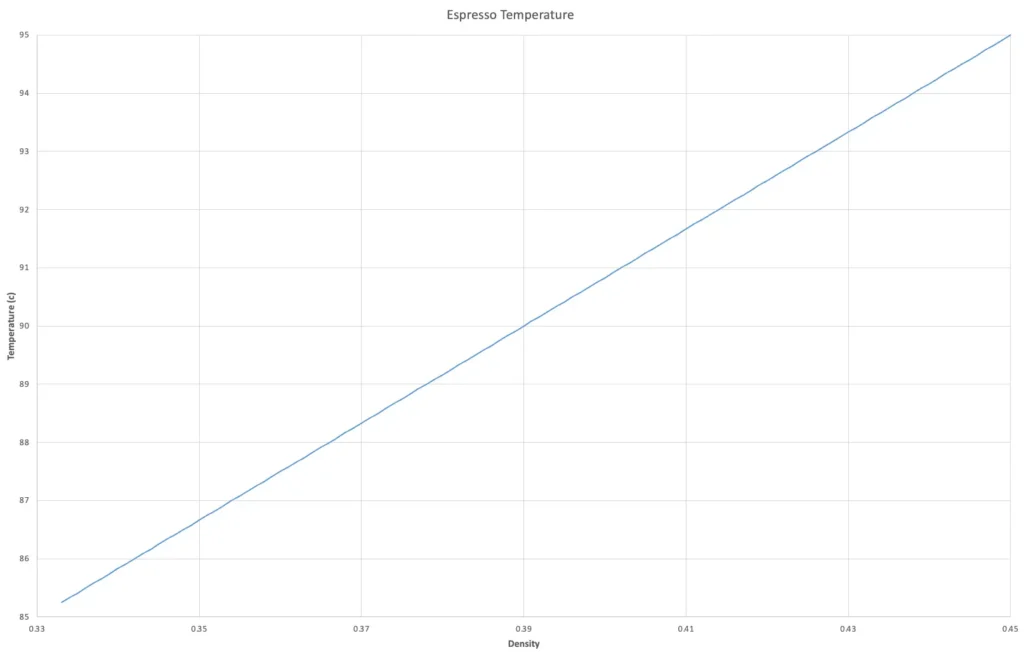
Espresso brew temperature (°C) against roasted bean density (g/ml)
at 0.330 g/ml, the darkest roasts (Recipe 1)
at 0.390 g/ml, the middle of the series (Recipe 61)
at 0.450 g/ml, the lightest roasts (Recipe 121)
Set your machine to the temperature on your recipe. Using a Flair 58? See the dial settings below.
Find your temperatureA short history
The number people repeat about espresso temperature, 93.5 °C, sounds precise enough to be a rule. It isn't. It's a rounded-off midpoint from a standard built for a different brew method, and treating it as gospel is a fairly recent habit, only possible once machines could hold a temperature steady at all.
Early machines ran steam and brew water off one boiler, at or above boiling point under pressure. Shots were routinely scorched, which is where espresso's old reputation for tasting burnt comes from.
The heat exchanger and the E61 group head (1961) separated boiler and brew water, but the exposed metal group pulled heat back out. Baristas learned to “temperature surf” by timing shots and flushing the group.
Hobbyists began wiring industrial PID controllers into their machines in the mid-2000s to hold boiler temperature within a fraction of a degree. Within a few years it was standard on prosumer machines.
PID control answered how to hold a temperature, never which one. 93.5 °C (also seen as 93 °C or 205 °F) sits near the midpoint of the old SCA brewing-water standard of 90.6–96.1 °C, a range worked out largely from filter coffee cupping. It's an easier number for a spec sheet than “it depends on the bean”. Push a mid roast to 93.5 °C and you're over-extracting it before you've adjusted anything else.
Flair 58
The Flair 58 sensibly limits the whole decision to three dial positions instead of a digital readout you can second-guess.
Dark roasts
Medium roasts, the most common
Light roasts
For the most common roast levels, setting 2 (90 °C) is the sensible default, not setting 3, whatever a 93.5 °C figure on a bag or in a machine's marketing might suggest.
Roast level is only a proxy. To match the setting to your actual bean rather than the category it loosely belongs to, measure its density and use the coffee density calculator. You get a recipe, temperature included, built for that coffee.
FAQ
It depends on the roast. Across the series it runs from 85 °C for the darkest roasts to 95 °C for the lightest, with 90 °C at 0.390 g/ml. Measure your bean density to find yours.
93.5 °C is a midpoint borrowed from the old SCA brewing-water standard, worked out largely from filter coffee. Mid roasts around 0.390 g/ml extract best at 89–90 °C; at 93.5 °C they are over-extracted before you've changed anything else. Read the short history.
Sour means under-extracted, and bitter means over-extracted. Rather than adjusting temperature on its own, press Extract More or Extract Less on your recipe and brew again.
Machines often report a boiler or group temperature rather than the water reaching the coffee. A probe thermometer, such as a Rhino long thermometer, lets you check what you are really brewing at.
Keep reading
Find your starting recipe, then dig deeper into what drives extraction.
Find your recipe
