


Updated October 2026 · dose by bean density
Dose means the weight of dry ground coffee. In the Coffee Recipe Series, the espresso dose changes with the density of your roasted beans: 25 g for the darkest roasts, down to 14 g for the lightest, spread evenly across all 121 recipes.
Light, dense roasts get a smaller dose; dark, low-density roasts get a bigger one. At 0.330 g/ml the dose is 25 g, at 0.390 g/ml it is 20 g, and at 0.450 g/ml it is 14 g. Measure your beans and the coffee density calculator picks the dose for you.
Why change the dose
When the ratio changes across the 121 recipes in the series, it is really useful also to change the espresso dose. Light roasts need high ratios and dark roasts need low ones, and the dose keeps the yield sensible at both ends.
A 14 g dose produces a just manageable 56 g yield of espresso. A larger 20 g dose would need a massive 80 g, which exceeds the brew chamber of devices such as the Flair 58.
Increasing the dose to 25 g keeps the yield up at 25 g, so you still get a proper shot rather than a thimbleful.
It is much easier to achieve high ratios when you reduce the dose. As the density indicates, using the right dose for the roast level helps get the extraction right.
The chart
Each dot is one recipe in the series. As density rises from 0.330 to 0.450 g/ml, the dose falls in a straight line from 25 g to 14 g.
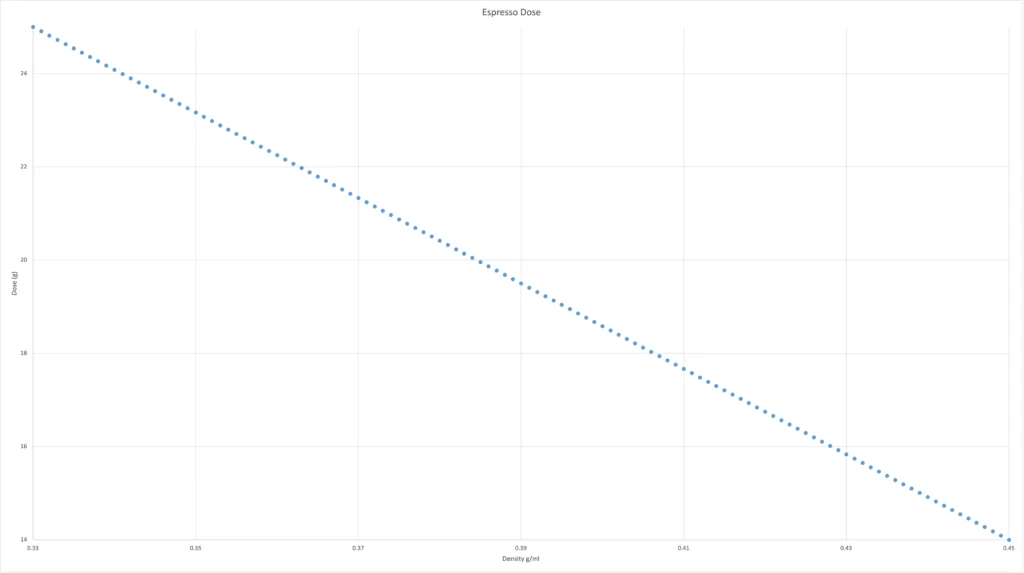
Espresso dose (g) against roasted bean density (g/ml), one dot per recipe
at 0.330 g/ml, the darkest roasts (Recipe 1)
at 0.390 g/ml, the middle of the series (Recipe 61)
at 0.450 g/ml, the lightest roasts (Recipe 121)
Weigh the dose on a 0.1 g scale, then pull the shot to the yield your recipe gives. If your basket can't take the dose, see the espresso yield calculator for how to keep the ratio.
Find your doseFAQ
The dose is the weight of dry ground coffee in the basket, in grams. Weigh it every time; it is one of the easiest variables to get exactly right.
Light roasts need high ratios, up to 1:4. A smaller dose keeps the yield to a volume your cup and your machine can handle, and makes those high ratios much easier to reach.
Keep the ratio and change the yield instead: yield = dose × ratio. For example, at a 2.5 ratio, an 18 g dose gives a 45 g yield. To match the basket to the dose, read how to choose an espresso basket.
Measure the bean density with a 100 ml cylinder and a 0.1 g scale, then enter it in the coffee density calculator. Your starting recipe shows the dose, ratio, yield and the rest.
Keep reading
Find your starting recipe, then dig deeper into what drives extraction.
Find your recipeMatch the basket to your dose for an even extraction.
Read the guide
