


Updated October 2026 · a 2-minute method
Weigh a measured volume of roasted beans, divide grams by millilitres, and you have your bean density in g/ml. That one number tells you roughly how light or dark the roast is, and picks a starting recipe that is usually right first time.
Density (g/ml) = weight of beans (g) ÷ volume (ml). Fill a 100 ml graduated cylinder with beans, pack them level, read the volume, weigh them, and divide. Example: 41.3 g ÷ 97 ml = 0.425 g/ml.
Why measure
Roast level drives how much extraction a coffee needs. Under-extract and it tastes sour; over-extract and it tastes bitter. Density turns roast level into a number: a dark roast is light and brittle enough to crush between your fingers, while a light roast is dense enough to resist a hammer.
of coffees don’t suit a fixed 1:2 recipe. A recipe picked by density is usually right first time.
of Extract More or Extract Less is almost always all it takes when the first recipe needs a change.
bags measured by CRS users. About 90% fall inside the 0.330–0.450 g/ml range the recipe series covers.
Want the reasoning and the maths behind the recipes? Read why measure roasted coffee density and Computational Coffee.
You can skip measuring. Start at Recipe 51 (380 g/L, the centre of recent measurements; see how the range was determined), and use Extract More or Extract Less from there. It works, but about 80% of the time that starting recipe won't be the right one, so expect more adjustment steps.
What you need
Class A, ±0.50 ml tolerance, preferably borosilicate glass. About US$15 for the Eisco Labs cylinder on Amazon, or from Lab Warehouse in NZ.
Any scale that reads to 0.1 g. The BOOKOO Themis Ultra is excellent.
Makes pouring beans into the narrow cylinder easier.
A short piece makes a good tamper for packing the beans level. Rolled-up cardboard works too.
The method
Watch the method, then follow the four steps below.
Put the empty 100 ml cylinder on the scale and tare it.
Pour beans in to near the 100 ml line. Tap the cylinder and pack the beans level with the dowel, topping up until the surface sits level close to 100 ml. Read the volume in ml.
Weigh the cylinder of beans. A light roast is heavy, as much as 48 g. A dark roast can be as little as 32 g.
Grams ÷ millilitres = density in g/ml. For example, 41.3 g ÷ 97 ml = 0.425 g/ml.
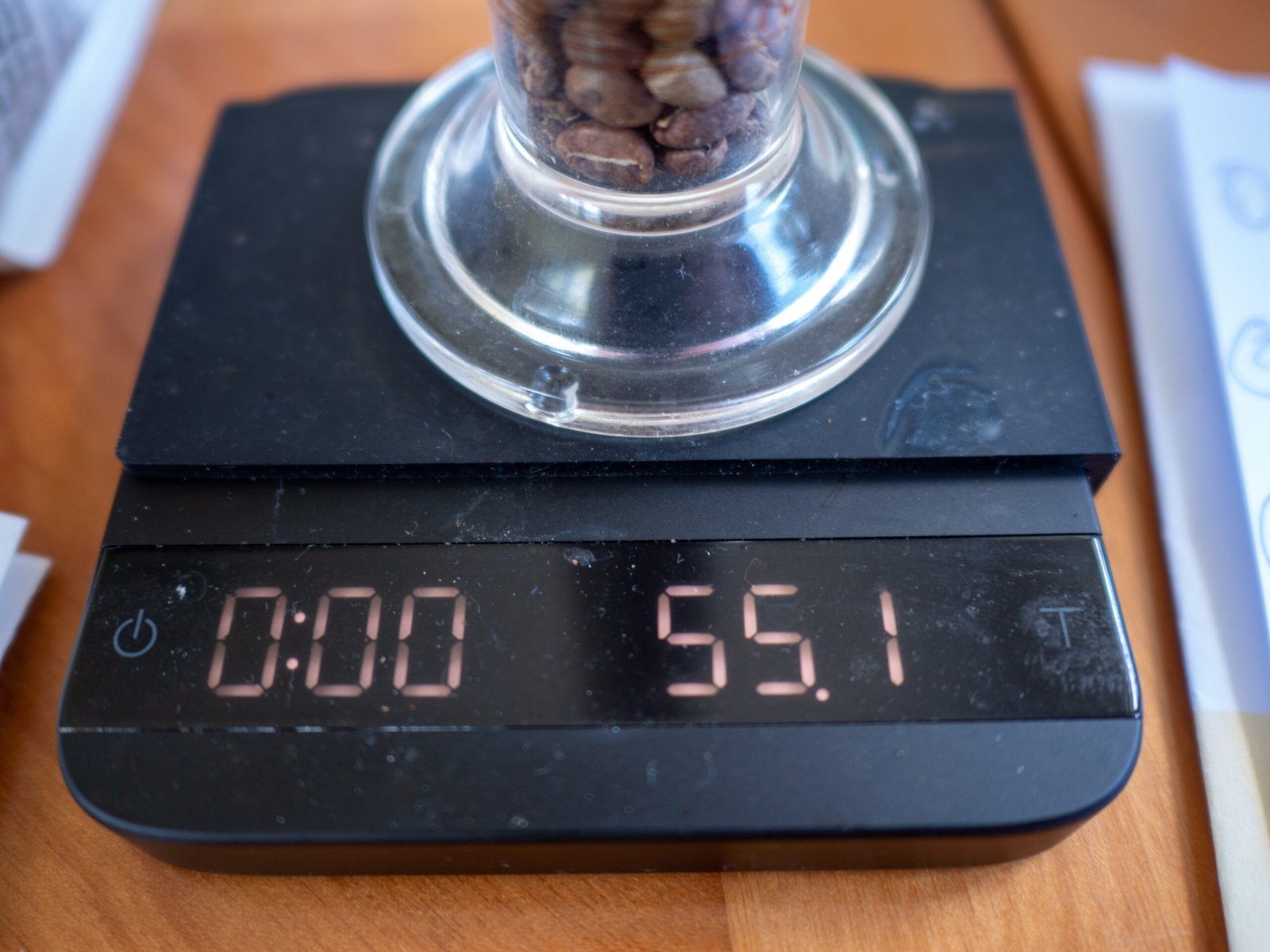
Lightly roasted beans: dense and heavy
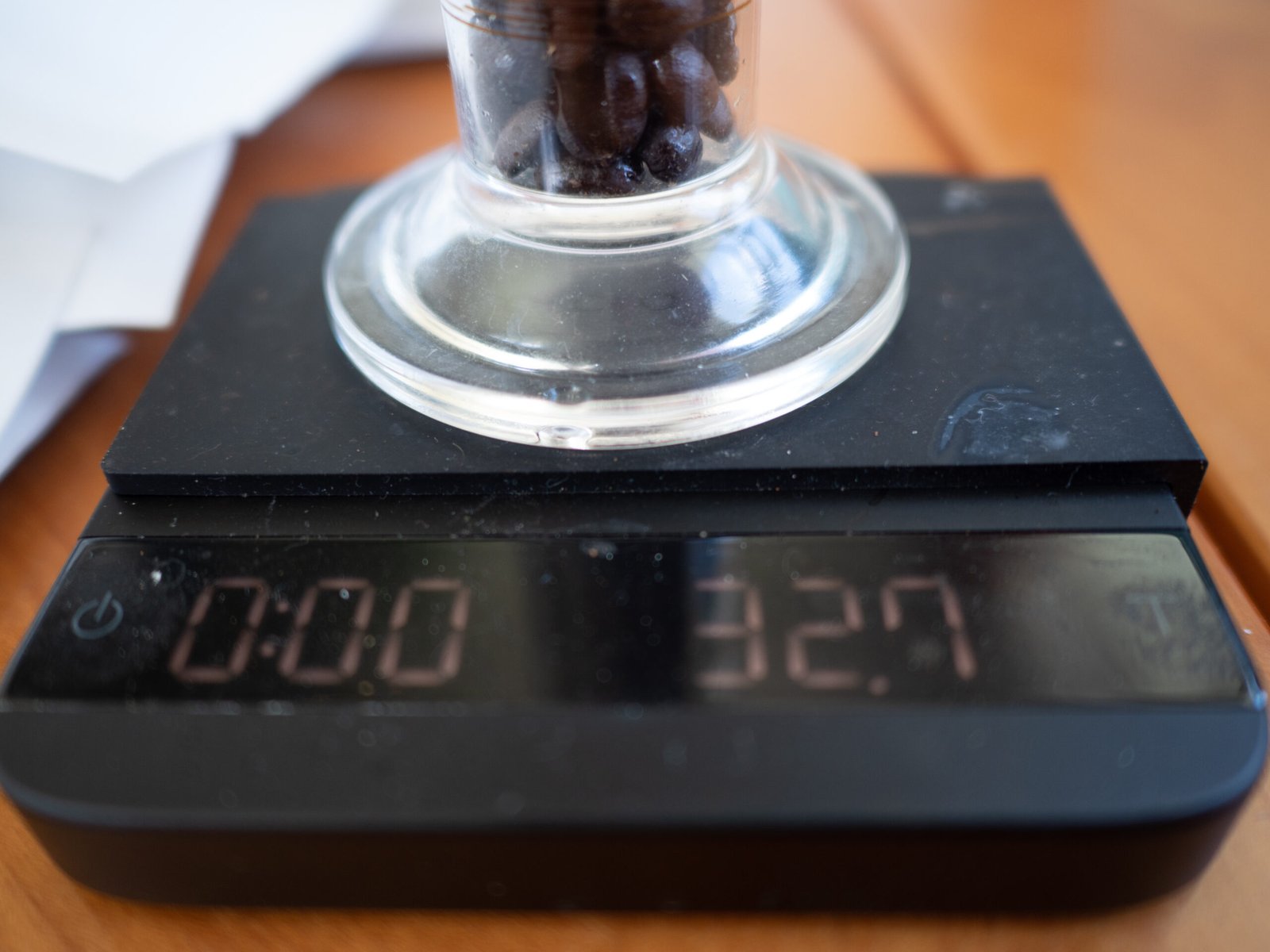
Darkly roasted beans: lighter for the same volume
The formula
Density = grams ÷ millilitres
41.3 g ÷ 97 ml = 0.425 g/ml
Enter your density in the coffee density calculator to get your starting recipe for espresso, filter, French press or AeroPress.
Sour? It's under-extracted: press Extract More and brew again. Bitter? It's over-extracted: press Extract Less.
FAQ
Almost all roasted coffee falls between 0.330 and 0.450 g/ml. Light roasts sit at the high end and dark roasts at the low end.
No. Pack the beans level, read whatever volume you have, and divide by that. Getting close to 100 ml just keeps the sample large.
0.1 g is enough. With 32–48 g of beans in the cylinder, a 0.1 g error moves the density by only about 0.001 g/ml.
Yes. One density gives you a matched starting recipe for espresso, filter, French press and AeroPress.
Keep reading
Find your starting recipe, then dig deeper into what drives extraction.
Find your recipeThe data and reasoning behind density-based recipes.
Read the guideMatch the basket to your dose for an even extraction.
Read the guide
