


Updated October 2026 · puck preparation
In espresso preparation, WDT stands for the Weiss Distribution Technique: stirring the ground coffee in the basket with fine needles before tamping. It breaks up clumps and evens out the coffee bed, so water flows through evenly instead of channelling.
Stir the grounds with fine needles for 5–10 seconds, then level and tamp. It breaks up clumps from the grinder and gives a more even, consistent shot. It's an extra step, but a cheap and simple one.
Why WDT?
Breaks up the static clumps that burr grinders produce, so there are no dense pockets or voids.
Water flows through the whole bed instead of finding a shortcut, so you avoid shots that are sour and bitter at once.
The same prep every time makes your shots more repeatable, which makes dialling in much easier.
Works with any espresso setup, from lever machines like the Flair 58 to pump machines.
The only drawback: it's an extra step, adding 10–20 seconds to your workflow.
WDT is named after John Weiss, who shared the technique on home-barista forums in the mid-2000s. It started as a simple hack with a needle or thin wire and has since become a standard part of espresso puck prep, with dedicated tools from many makers.
How to do it
Grind and dose your coffee into the basket, and tap gently to settle.
Hold the portafilter level and insert the needles vertically, about 1–2 cm deep.
Stir in small circles or spirals, working across the whole bed and out to the edges, for 5–10 seconds. Don't press down; let the needles do the work.
Lightly level the surface, then tamp with even pressure.
Lock in and pull your shot to the yield on your recipe.
Tools
You don't need fancy gear: a thin needle or an opened paperclip works in a pinch. A dedicated tool with several fine needles is quicker and more consistent, and some, like the Normcore, offer interchangeable needles. At the high end, spinning distributors such as the Weber Moonraker automate the stirring.
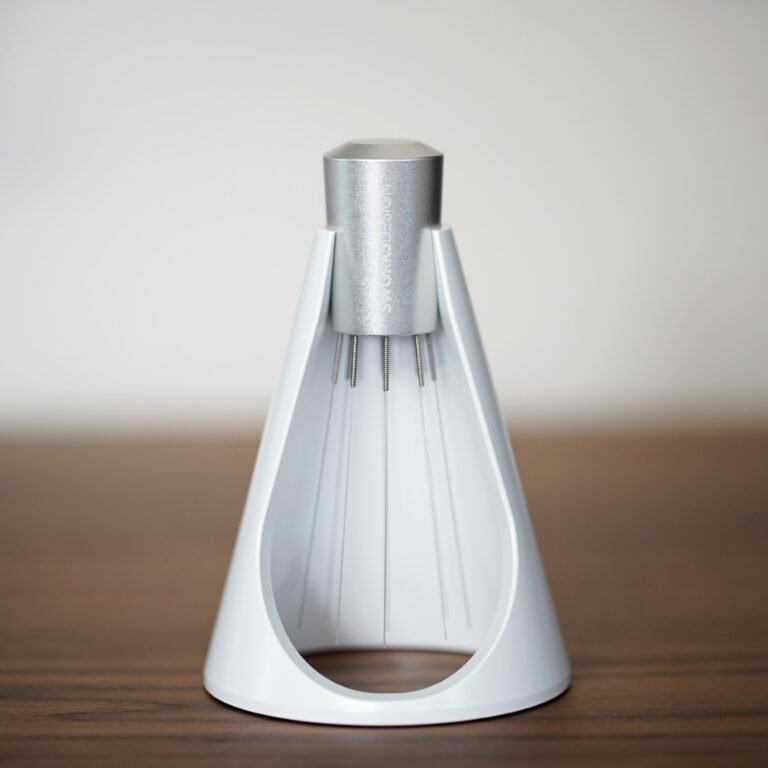
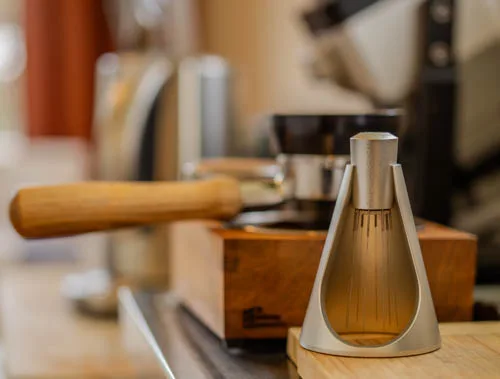
Machined from anodised aluminium, with a Delrin insert that holds up to 17 needles, though up to 9 is recommended. It uses very thin 0.22 mm and 0.25 mm needles with rounded ends, where many tools use 0.4 mm. Thin needles fluff and separate the grounds; thicker ones tend to push the coffee around and can create new clumps. You can alternate the two thicknesses: the flexible ones reach into clumps, the stiffer ones keep the bundle spaced. Magnets in the end of the handle hold it in place.
Myths
Nope. WDT is complementary: distribute first, then tamp.
Not if they push the coffee around. Thin needles fluff and separate; thick ones act like a rake.
Check grind size, dose and temperature first. WDT isn't a cure-all; see what causes channelling.
Keep reading
Find your starting recipe, then dig deeper into what drives extraction.
Find your recipeA spritz of water before grinding for less static and fewer clumps.
Read the guideMatch the basket to your dose for an even extraction.
Read the guide
