


Updated October 2026
The grinder is the most important piece of equipment you own. To maximise flavour, choose a single-dose burr grinder with precisely aligned all-metal parts, large flat steel burrs, slow speed and zero retention, and grind fresh coffee just before you brew.
I have spent five times more on my grinder than on my espresso machine, and I would do it again. These fifteen tips explain what to look for, and why.
Grind uniformity is what reveals flavour. Burr alignment and tight tolerances come first, so pick a well-engineered all-metal burr grinder over a plastic one, never a blade grinder, and grind only what you need for each brew.
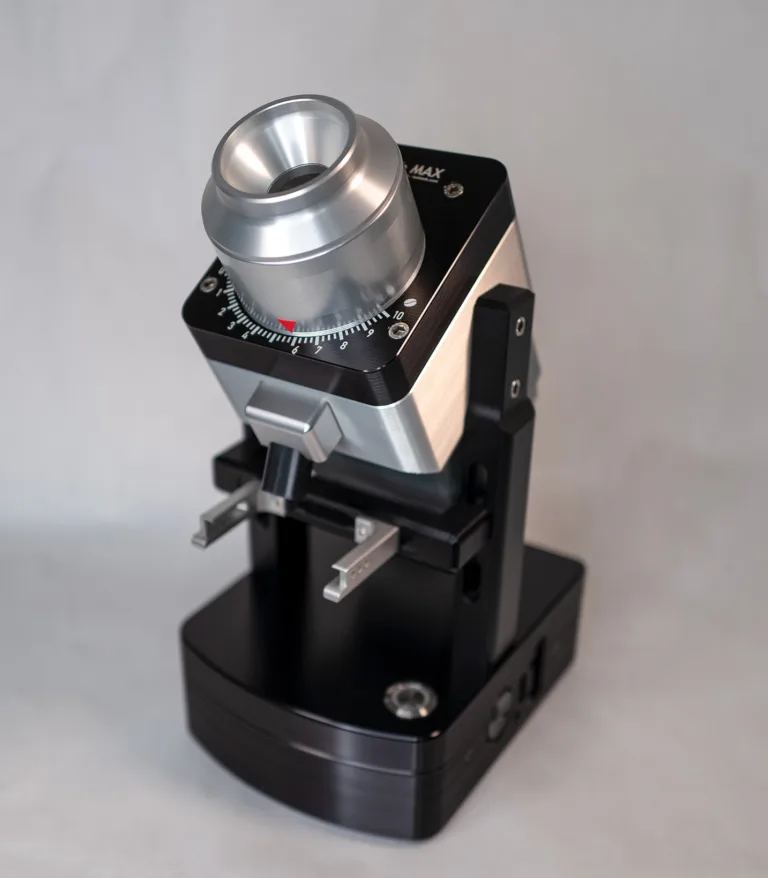
My KafaTek Monolith Flat MAX, one of the world’s best coffee grinders.
Each tip links to the full explanation further down the page.
Tip 1
Stored airtight at room temperature, whole-bean coffee loses 90% of its aroma 3–4 weeks after roasting, while ground coffee loses 90% within one day.
The aromas do not degrade at the same rate. The first to go are the sweet, fruity notes, and the last are the malty, roasty, nutty notes, which is why so much pre-ground coffee tastes the same: uniformly lifeless.
409: The Science of Optimizing Your Espresso with Samo Smrke – Keys to the Shop (Spotify podcast)
The wonderful, diverse, complex fruit tastes and smells you see on the Coffee Taster’s Flavour Wheel can’t be experienced unless you use fresh, well-stored coffee, ground with a good grinder just before brewing.
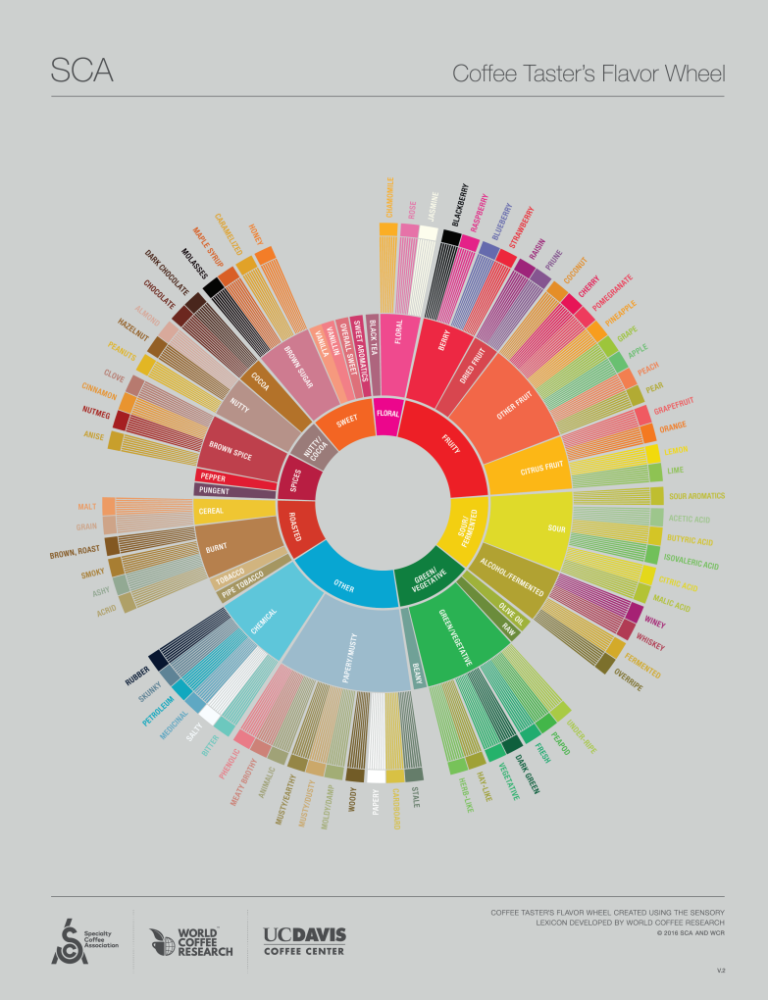
The SCA Coffee Taster’s Flavour Wheel.
A lot of people say that, or “my taste buds are not that refined”, or “coffee nerds have pure imagination”. Many have simply never tasted good specialty coffee with optimum freshness, uniform grind and good extraction. That is sad. Life is too short to drink bad coffee.
Tip 2
Another reason to grind yourself is control over grind size. You need a different grind for each extraction method, and a different grind for each roast level:
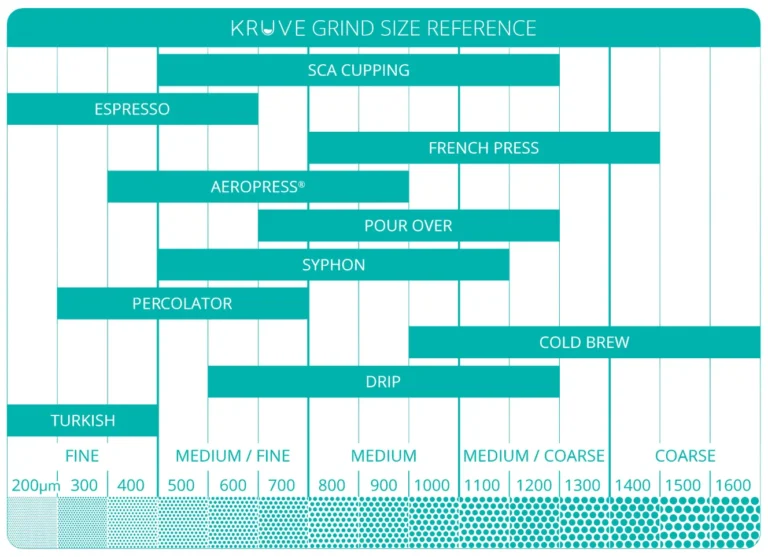
Grind size reference chart from Kruve: match the grind to the brew method.
Roasting weakens the bean’s cell structure, making it brittle, porous and much more soluble. Grind coarser to avoid bitter over-extraction.
The cell structure stays very hard and not very soluble. Grind finer to avoid sourness from under-extraction.
Grind size also controls how long the water is in contact with the coffee. Grind finer to slow an espresso puck down, or coarser to speed it up. The same applies to the draw-down of a V60 or Hario Switch.
You can make better coffee than most cafés. Cafés tend to serve a generic blend for high-volume consistency and have to turn out a lot of coffee quickly. At home you have no such limits: you can use the best coffee and take all the time, care and attention you like.
But you do need one thing: a good grinder, preferably the best grinder you can find.
When I first started in coffee, I thought it ridiculous to claim you could taste a grinder. I know people who have only ever used a blade grinder with a French press or a moka pot. But having now used a range of grinders, I have happily spent five times more on my grinder than on my espresso machine. The grinder is the most critical piece of equipment. The most important thing it must achieve is the best grind uniformity possible.
Tip 3
One incident really brought home to me how much the grinder affects flavour.
At home I have what is widely considered one of the world’s best coffee grinders, the KafaTek Monolith Flat MAX: 98 mm Shuriken Light/Medium flat burrs, 400 rpm, stepless adjustment, hopper-less single dosing, zero retention, bellows, all-metal build with the highest tolerances and exceptional burr alignment.
I once had an amazing Indian coffee from Balmaadi Estate, with beautiful sparkling strawberry and tobacco notes (natural process, Kent, S795). I was telling an Indian friend at work how great it was, and he really wanted to try it.
At work I had a Fellow Ode: certainly nowhere near as expensive as the KafaTek, but still a flat burr (64 mm, 1400 rpm, stepped, plastic parts). Ground with the Ode, the Balmaadi tasted of flat, damp earth and hessian. Nothing I tried could reveal the beauty I knew that coffee was capable of.
I upgraded the Ode to SSP Red Speed Coated 64 mm flat brew burrs, but it did not fix the problem. When I measured the grinds with a Kruve Brewler, it was obvious that the Ode lacked the tight engineering tolerances needed for perfect burr alignment.
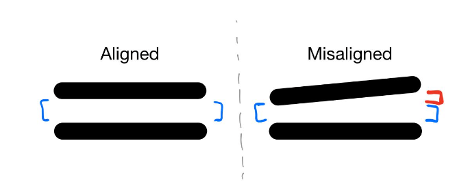
I eventually replaced the Ode with a much more expensive and well-engineered Option-O Lagom P64 with 64 mm SSP Unimodal Espresso/Multipurpose flat burrs.

During extraction, large particles known as boulders don’t saturate, under-extract and produce sourness. Small particles known as fines, under 100 microns, over-extract and produce bitterness. The greater the variety of particle sizes, the more the cup’s noise obscures the flavours. Grind uniformity is the key to revealing flavour in great coffee.
Cheaper grinders have plastic parts that can’t achieve perfect burr alignment and tight tolerances. It is well worth buying a CNC-machined metal grinder (such as Option-O) over a plastic one. Burr alignment is the most important aspect, so I would not purchase a plastic grinder, and that includes the Niche Zero and Fellow Ode. (Lance Hedrick: 1 year with the Niche, AG4Tech Niche Zero review)
Going from a blade grinder to any burr grinder is a massive improvement. Going from one burr grinder to a progressively more expensive one does not follow the law of diminishing returns. The flavour separation you get from a perfectly aligned burr is miles ahead of misaligned burrs, and if your burrs are misaligned it doesn’t matter how good they are. Instead of diminishing returns, it is the law of increasing returns.
That is why a grinder with the best possible burr alignment is a worthwhile investment if you want to explore the variety of coffee flavours. It is also why an extraordinary hand grinder like the Kinu M47 Classic can outperform many electric grinders that cost a lot more.
CNC-milled 10-micron tolerances. If you see plastic parts, it can’t be good. However, a cheap all-metal grinder might not be very good either: that level of precision is difficult and expensive to achieve.
For example, here are the issues James Hoffman found with the first-generation DF64: a small espresso adjustment range, poor holder forks, a rudimentary declumping screen that causes retention, regrinding that gives muddy harshness, 1400 rpm and high static, difficult access to the burrs, and a design that doesn’t clear the grind chamber adequately. These issues have largely been addressed in generation 2.
Tip 4
Blade grinders just smash the beans up. There is virtually no grind uniformity, and they produce a lot of fines. A particle distribution curve looks like this:

If you are using a blade grinder, do yourself a massive favour and get a burr grinder.
Sifting doesn’t remove all the small particles. Millions are still stuck to the larger grinds: when coffee is torn apart in the grinder, pockets of positive and negative charge attract the fines. Sifting is pretty useless for particle separation and testing.
Tip 5
Static electricity is a much bigger problem than most people give it credit for. Coffee beans are very dry, and a 1400 rpm grinder creates a massive amount of friction. Every grinder produces fines, even the most expensive grinder with low-speed big flat burrs.
The fines are microscopic, so you can’t see them. There are millions of them, and static makes them stick to all the grinds. If you see clumps, or coffee sticking to the exit chute, you need more RDT.
The Ross Droplet Technique is spraying the beans with a little water before grinding, and I highly recommend it. It is far more effective than deionisers, anti-clumpers and WDT tools. RDT not only reduces static, it improves flavour. (Link to paper)
RDT will likely increase retention in the grinder, and you can even get wet whole beans sticking to a wall. Being able to open the grinder and brush the walls and burrs before and after every grind is a big help, so easy access to the burrs is another design feature to look for.
Tip 6
There are two types of burr grinder: conical and flat.
One burr sits inside the other like a cup, and the beans are gravity fed. The gap is widest at the top to let the beans in and smallest at the bottom for the final grind size. The grinding is bimodal: the beans are first shattered at the top, producing more fines, then ground to the size that will exit. A particle distribution curve shows a double hump.
Two disks lie “flat” against each other, often horizontally aligned with angled teeth, and the beans are centrifugally fed. The particle distribution curve typically shows a more unimodal single peak. That doesn’t mean every flat burr grinder beats every conical one: burr alignment is of primary importance, so a cheap flat will be outperformed by an excellent conical.
Flat burrs first came to the fore in 2014 when Matt Perger used a Mahlkönig EK43 at the World Barista Championship, and their popularity has risen since, particularly among espresso enthusiasts. Mahlkönig’s marketing calls the EK43 “the undisputed queen of coffee grinders”. Opinions differ. It was designed as a spice grinder, with 1750 rpm and a large hopper, and in James Hoffman’s test of top-end grinders it came last, beaten by the much smaller, cheaper Option-O P64.
Flat burr grinders are generally more expensive, and most domestic grinders are only conical, but the market is evolving rapidly and there are now economical flat grinders: DF54 review: They just disrupted the grinder market.
The bigger the burrs, the more cutting surfaces and the greater the throughput, generating the least friction and static. But don’t forget burr alignment: smaller burrs with better tolerances will outperform a cheap big-burr grinder. Bigger is not necessarily better.
For retention, an angled flat burr grinder is better than a vertical one, because the tilt helps gravity dislodge the grinds. Static also builds grinds up in the exit chute. Some grinders provide knockers, but I prefer the magnetic removable exit chute on the KafaTek Monolith Flat MAX.
Tip 7
Ceramic burrs are moulded, so they are not as sharp or as uniform as steel burrs. They are also less durable and can be chipped by foreign material, such as a tiny stone in with the beans, which does happen.
Some people say ceramic is suitable for reducing heat. You do want as little heat as possible, because heat burns the oils in the beans and “cooks” them during grinding, which hurts flavour. But in low-volume domestic grinding, heat isn’t much of a consideration.
Some people maintain that ceramic burrs give a distinct mouthfeel and more body than stainless steel. That extra body comes from producing more bitter fines that obscure flavours. Those terms should raise a red flag. Ceramic burrs are more akin to blade grinders and are best avoided.
Tip 8
Sung Sim Precision, better known as SSP, is a South Korean brand that specialises in high-quality aftermarket burrs.
Choosing a grinder that can take upgraded burrs is worthwhile.
Tip 9
High speed is not good. It produces more friction, static and fines. 400 rpm will produce better-tasting coffee than 1500 rpm.
A slow motor needs to be powerful so it does not stall on light roasts. Even the Weber EG1 suffers from stalling. You can feed it slowly to help reduce stalling.
Tip 10
Coffee is degraded by oxygen, temperature and moisture. The storage and grinder requirements of high-volume cafés are therefore very different from those of a low-volume domestic grinder at home.
Busy coffee shops get through kilos of coffee a day. Sealed 3 kg bags come from a roaster and are used within days. When one is opened and poured into the hopper, the coffee is all ground and used within hours. It doesn’t sit around long after roasting, and it isn’t in the open for long. The weight of coffee in the hopper helps feed the grinder, and retention matters much less because there is little time for coffee to stale in the grinder.
The quickest way to ruin your coffee at home is to store it in a hopper. There is a 50% decrease in shelf life for each 10°C increase in temperature. The only way to slow staling is to freeze, because freezing slows kinetic reactions. Store in single doses for maximum freshness, and freeze your coffee as soon as possible.
An excellent domestic grinder will not have a hopper. It will be designed for grinding a single dose, without the weight of beans in a hopper, and will have an anti-popcorning device to stop the beans bouncing out. The grinder has to be designed for single dosing.
“The Eurekas are traditional flat burr grinders, not suitable for single dosing. I have used several Mignons and one of their 64 mm grinders, and they become mediocre to poor when the hopper is not full enough. That is especially apparent for finer grinds, when the grinder slows down and the grinds become inconsistent. These same grinders will happily churn out Turkish powder if you fill the hopper. The Niche is designed for single dosing and is highly consistent.”
Tip 11
The grinder needs to be designed for zero retention. Bellows help ensure there is no yesterday’s stale coffee left in the grinder, and you don’t waste beans purging. An angled flat burr grinder usually has less retention than a vertical one.
Top domestic grinders are specialities in their features. You want single dosing, not a hopper full of beans like a coffee shop. Designing for perfect burr alignment, single dosing, anti-popcorning and zero retention all at once is difficult.
Tip 12
Most people don’t realise how much their grinder is holding them back. Many go on a grinder journey, starting with a cheap grinder and then making a series of upgrades, wondering what the top grinders could do for them. This is mine, and what I found on the way.
I wanted to start with a cheap but allegedly reasonably good grinder, to see whether I could make decent coffee at home that I would be happy with, and whether home coffee was worth investing in.
You can get a better hand grinder for the same price as an electric one, and you will have something to take on holiday.
Tip 13
My first grinder was the well-regarded 1Zpresso JX Pro. I could make good coffee with it, so it passed that test, but I had two issues. First, the problem with all hand grinders is that you get sick of putting the effort in, and light roasts can be a real pain. You will want an electric grinder at some point. Second, the 1Zpresso is stepped, and for espresso on my Flair Pro 2 I often needed to be in between steps. Being stepped was frustrating.
I was determined to get the best electric grinder on the planet. But you can’t just walk into a shop and buy it, or even order it online. It took me two years to get my KafaTek.
In the meantime I wanted a better hand grinder to tide me over and keep for travel, so I bought the Kinu M47 Classic: an excellent stepless conical burr hand grinder built like a tank. I also added the optional silicone band, which helps considerably when grinding light roasts. The factory setting at zero was perfect, I have had it for years, and I have no need or desire to upgrade it.
The Commandante is another hand grinder many people go for, but it is stepped. You can get Red Speed half-clicks, but I still wouldn’t do it myself. Counting clicks is tedious.
It came down to a choice between the KafaTek Monolith Flat MAX and the Weber EG1. The EG1 may be better looking, but it has smaller burrs, fewer burr choices and an underpowered motor that can stall on light roasts. The KafaTek has been excellent.
For my grinder at work, as covered under Tip 3, I regretfully started with the Fellow Ode, tried SSP burrs, and then replaced it with the Option-O P64. What I prefer on the KafaTek over the P64 is a much bigger adjustment wheel, easier access to brush the burr chamber, a removable magnetic funnel, faster grinding and better taste. Option-O now also have the larger Option 01 and P100 models.
Tip 14
You can’t make a silk purse out of a sow’s ear. Get yourself a lovely specialty coffee, a good variety such as Colombian Caturra or an Ethiopian landrace, from a good producer. It will outperform your generic blended coffee.
Tip 15
Once you have good coffee, keep it good. Freeze it in single doses as soon as possible after roasting, and grind it straight from the freezer.
My picks
These are the grinders I have used or researched, matched to budget. Remember the tips above: precise burr alignment, steel burrs, slow speed, single dosing and zero retention.
Starting out
If you are starting out and want something cheap but good.
Visit MiiCoffee DF54 Single Dose Coffee Grinder Watch the DF54 reviewVery good
If you want something very good and are prepared to pay.
Visit Option-O Lagom P64 Watch James Hoffman’s P64 reviewThe best
If you just want the best and money is no object.
Visit KafaTek Monolith Flat MAX Watch James Hoffman’s reviewStarting out
If you are starting out and want something cheap but good.
Visit 1Zpresso hand grindersThe best
If you just want the best hand grinder.
Visit Kinu M47 Classic Watch a reviewFAQ
There is no single answer, but grind uniformity is what matters. Look for precise burr alignment and tight tolerances, an all-metal build, large flat steel burrs, slow speed, single dosing and zero retention. My picks are the MiiCoffee DF54 to start, the Option-O Lagom P64 for something very good, and the KafaTek Monolith Flat MAX if money is no object. For a hand grinder, the Kinu M47 Classic.
Yes. Blade grinders smash the beans, with virtually no grind uniformity and a lot of fines. Going from a blade grinder to any burr grinder is a massive improvement.
Large flat burrs typically give a more unimodal particle distribution, while conical burrs give a double hump. But burr alignment is of primary importance, so a cheap flat grinder will be outperformed by an excellent conical one.
I would avoid them. Ceramic burrs are moulded, so they are less sharp and less uniform than steel burrs, and they can chip. Claims of extra mouthfeel and body usually come from more bitter fines obscuring flavour.
RDT is the Ross Droplet Technique: spraying the beans with a little water before grinding. It reduces static and clumping and improves flavour, and I highly recommend it. It can increase retention, so choose a grinder with easy access to the burrs.
At home you use far less coffee than a café, so beans left in a hopper go stale. Storing coffee in a hopper is the quickest way to ruin it. A single-dose grinder also avoids relying on the weight of beans to feed the burrs.
Yes. High speed produces more friction, static and fines, and 400 rpm will produce better-tasting coffee than 1500 rpm. The motor needs to be powerful enough not to stall on light roasts.
A hand grinder can match or beat an electric one at the same price, and you can travel with it. The downsides are the effort and that light roasts can be a pain, so you will probably want an electric grinder at some point.
No. Stored airtight at room temperature, whole-bean coffee loses 90% of its aroma 3–4 weeks after roasting, while ground coffee loses 90% within one day.
Keep reading
A good grinder deserves good coffee, stored properly and brewed to a recipe that suits it.

